Dreame vs Roomba in 2026: Spec Monster or Simpler Robot?
Almost nobody cross-shops these two brands by accident. Dreame sells the biggest numbers in the category, iRobot sells the most familiar name in it, and the two companies have spent 2026 moving in noticeably different directions. Choosing between them is a choice between engineering ambition and everyday simplicity.
Quick Answer
Buy Dreame if you want maximum capability and don’t mind managing more settings — the X60 Max Ultra Complete runs 35,000 Pa in a 3.13 in body, and the Aqua10 Ultra Roller clears 42 mm thresholds while washing its roller mop at 212°F. Buy Roomba if you want a robot that’s easy to live with — iRobot’s suction ratings are far lower, but the dual rubber brushes, PrecisionVision AI obstacle avoidance, and a much simpler app make it the less demanding daily machine, with US service and parts availability that Dreame can’t match. Put bluntly: Dreame wins the spec sheet, Roomba wins the setup drawer.
Spec Comparison
| Feature | Dreame flagship line | Roomba current line |
|---|---|---|
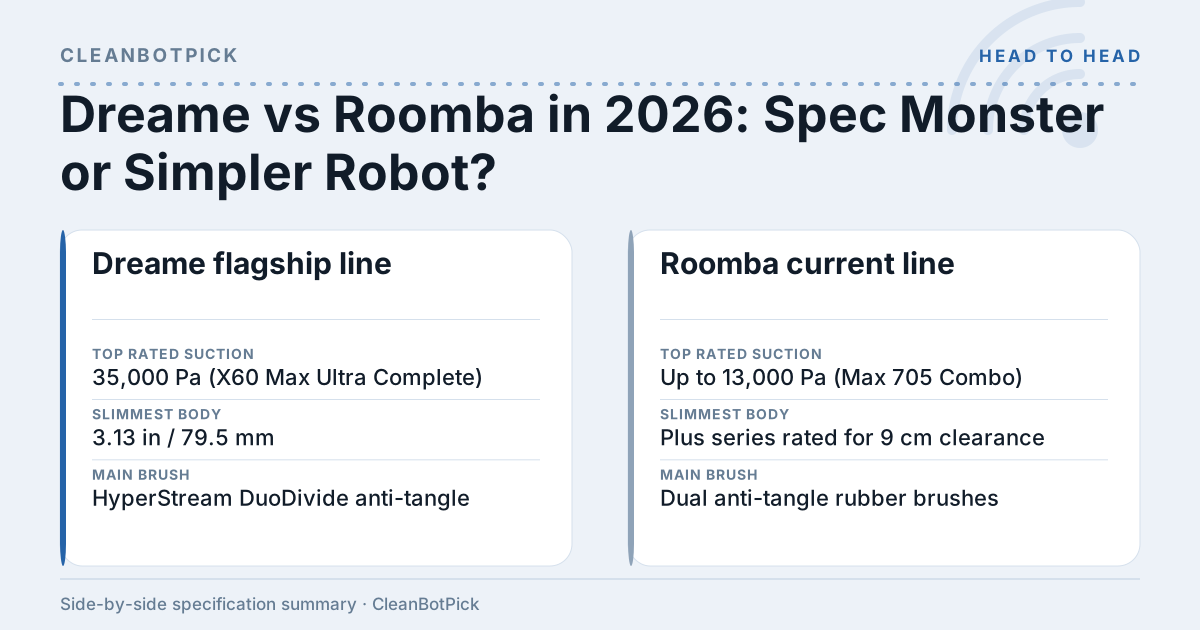
| Top rated suction | 35,000 Pa (X60 Max Ultra Complete) | Up to 13,000 Pa (Max 705 Combo) |
| Slimmest body | 3.13 in / 79.5 mm | Plus series rated for 9 cm clearance |
| Main brush | HyperStream DuoDivide anti-tangle | Dual anti-tangle rubber brushes |
| Mopping method | Dual spinning pads (X60) or FluffRoll roller (Aqua10) | PowerSpin roller mop, 200 RPM + SmartScrub |
| Mop pressure | 15N downforce on X60 Max Ultra Complete | Not published as a figure |
| Mop lift | 21.5 mm (X60), 0.55 in chassis lift (Aqua10) | Retractable cover engages over the mop |
| Threshold climbing | ProLeap: 42 mm single, 60 mm tiered (Aqua10) | Standard chassis |
| Obstacle avoidance | Binocular AI cameras, objects from 1 cm; OmniSight 2.0 recognizes 240+ objects | PrecisionVision AI + ClearView Pro LiDAR |
| Mop wash temperature | 212°F roller wash (Aqua10) | 161°F water, 121°F air dry |
| Dock capacity | Up to 100 days auto-empty (Aqua10 PowerDock) | Up to 75 days auto-empty (AutoWash Dock) |
| Runtime | Up to about 3 hours (X60 Max Ultra Complete) | Around 120 minutes (Max 705 Combo) |
If you want the most capable machine on the floor
Dreame, without much argument. The X60 Max Ultra Complete packs 35,000 Pa into a 3.13 in (79.5 mm) chassis with retractable LiDAR, which is a genuinely difficult piece of engineering — most robots that thin give up navigation hardware to get there. It adds 15N of mop downforce, 21.5 mm of mop lift, an extending edge mop, a removable mop for vacuum-only runs, and binocular AI cameras with Proactive Illumination that Dreame rates for detecting objects as small as 1 cm.
The Aqua10 Ultra Roller takes a different swing. It trades some suction (30,000 Pa) for a full-width FluffRoll roller mop with an Aquaroll system that continuously sprays clean water onto the roller while collecting dirty water in real time, plus a counter-rotating secondary roller to keep the mop from packing down. Its ProLeap suspension clears 42 mm single thresholds or 60 mm tiered ones, its chassis lifts 0.55 in to keep rugs dry, OmniSight 2.0 recognizes 240+ objects, and the PowerDock washes the roller at 212°F and holds debris for up to 100 days.
Those are not incremental numbers. If your home has awkward thresholds, low furniture, or thick carpet, Dreame builds hardware that other brands simply don’t. Our Dreame lineup guide ranks where each model lands, and the X60 Max Ultra review goes deeper on the flagship.
If you want a robot that just works without a manual
This is Roomba’s remaining advantage, and it’s real. The Max 705 Combo — one of the models iRobot currently fronts its lineup with — is rated at up to 13,000 Pa, a fraction of Dreame’s headline figure — but it pairs dual anti-tangle rubber brushes with Carpet Boost, and rubber brushes agitate carpet fibers in a way that partially offsets a suction deficit. It mops with a PowerSpin roller at 200 RPM with SmartScrub adding back-and-forth pressure, covers that roller when it detects carpet, and docks into an AutoWash base that washes with 161°F water, dries with 121°F air, refills, and self-empties for up to 75 days.
The bigger difference is in how the two brands treat you. ClearView Pro LiDAR names rooms automatically. PrecisionVision AI recognizes cords, shoes, and pet waste without you training it. The app has fewer knobs, which is a downside if you’re the kind of person who wants per-room water levels and a downside for nobody else. Dreame’s app gives you far more control and expects you to use it.
Support matters too. iRobot has a long-standing US service and parts operation; Dreame’s replacement-part supply and warranty handling in North America are newer and less predictable. For a robot you plan to run for four or five years, that’s not a footnote.
If you’re weighing whether the brand still earns its price, our is Roomba worth it in 2026 piece covers that directly.
What each brand shipped in 2026
Both refreshed heavily this year, in opposite directions.
iRobot announced eight new Roombas on July 7, 2026, its broadest refresh in years. The Max 775 Combo takes over as the flagship with what iRobot describes as 4x more power-lifting suction, a vacuum-only Max 715 sits beside it, and the Roomba Plus 415, 515, and 575 Combo robots are described as 46% smaller than the previous generation — small enough for homes with as little as 9 cm of furniture clearance. Crucially, LiDAR and PrecisionVision AI are now standard from the Plus 415 upward instead of being flagship-only. Those models started rolling out from mid-2026, so ownership history is still thin.
Dreame, meanwhile, has kept iterating on roller mopping and terrain handling, with the Aqua10 series pushing self-rinsing rollers and the X60 line pushing thinness and suction simultaneously. Additional models including a steam-mopping Aqua 20 Pro Roller Ultra have been announced but are early in distribution, so treat those as future options rather than things to buy today.
The pattern is clear enough: Dreame is racing on capability, iRobot is racing on accessibility. Neither strategy is wrong, but they produce very different robots.
FAQ
Is Dreame better than Roomba in 2026? On specifications, comfortably — more suction, thinner bodies, better threshold climbing, hotter mop washing, longer runtime. On ease of ownership, app simplicity, obstacle recognition reliability, and US service access, Roomba still holds ground. Pick based on which of those you’ll notice more.
Does Roomba’s much lower suction number actually matter? Less than the gap suggests, but it isn’t nothing. Pascal ratings measure sealed pressure, not airflow, and Roomba’s dual rubber brushes do more mechanical agitation than most brush designs. On hard floors you won’t notice a difference. On thick carpet with embedded pet hair, Dreame pulls ahead.
Which brand is better for pet hair? Both handle it, and both use anti-tangle brush designs. Dreame’s higher suction gives it the edge on deep carpet; Roomba’s rubber brushes resist hair wrap well and PrecisionVision’s ability to recognize pet waste avoids the worst possible outcome. Our pet hair rankings cover the field.
Which is easier to set up and live with day to day? Roomba. Automatic room naming, fewer settings, and a simpler app mean less time in configuration screens. Dreame rewards people who want granular control and frustrates people who don’t.
How do these two compare to Roborock and Ecovacs? Roborock generally sits between them — flagship capability with a well-polished app. Ecovacs pushes bagless docks and roller mopping hardest. We compare them directly in Roborock vs Dreame, Ecovacs vs Dreame, and the four-way Roomba vs Ecovacs vs Dreame vs Roborock.
Should I wait for the newest models from either brand? If you need a robot now, buy a model that’s actually in distribution with documented owner feedback behind it. Both brands have announced hardware that hasn’t fully reached retail, and early firmware on brand-new platforms is where most complaints originate.
Conclusion
Dreame builds the more impressive machine. Roomba builds the more forgiving one. That framing survives almost every specific comparison you can run between them.
Go Dreame if your home has thresholds, low furniture, thick carpet, or floors that need aggressive mopping — and if you’ll enjoy tuning the settings rather than resenting them. Go Roomba if you’d rather open the box, run one setup pass, and never think about it again, and if long-term US service access factors into a purchase you expect to keep for years. If you want a broader look at how the brands stack up, Roomba vs Roborock covers the other half of this matrix.